Global PerspectiveComparative Policy
How Governments Around the World Have Addressed Historical Injustice
From Holocaust restitution to Japanese American redress and Indigenous settlements.
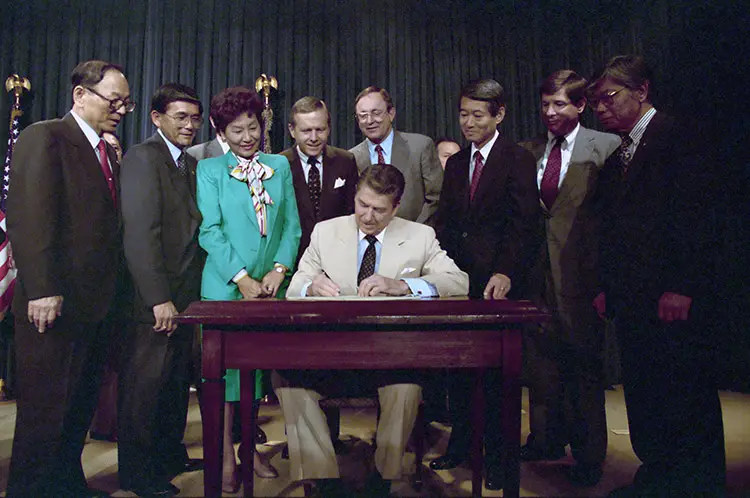
Governments have addressed historical injustice through property restitution, individual compensation, negotiated settlements and public acknowledgment. The strongest material precedents did not stop at declaring that something terrible happened. They established obligations and mechanisms for transferring value.
These histories offer administrative lessons for reparations owed to descendants of American slavery. They do not establish identical injuries, interchangeable eligibility or a universal payment formula. Each remedy belongs to a particular wrong and legal relationship.
Germany’s settlement was not one universal check
The Luxembourg Agreement, signed on September 10, 1952, committed West Germany to deliveries of goods to Israel valued at three billion Deutsche Marks over twelve years. Associated arrangements provided 450 million Deutsche Marks for assistance through the Conference on Jewish Material Claims Against Germany.
Deliveries to a state, assistance administered through an organization and individual compensation are different channels. Germany’s reparations history cannot be compressed into a single program in which every victim or descendant received the same benefit.
A government can recognize responsibility through several instruments. But institutional spending is not the same as assets personally owned by injured people. Our examination of Germany’s Holocaust reparations explores that distinction.
Japanese American redress joined acknowledgment to payment
The Civil Liberties Act of 1988 acknowledged the injustice of wartime evacuation, relocation and incarceration of people of Japanese ancestry. It provided an apology, public education measures and $20,000 payments to eligible individuals. The statute defined eligibility, including its survival requirement. It did not provide unrestricted payments to everyone with Japanese ancestry.
Congress connected recognition to a specified material remedy and an administrative process. That matters: the law addressed both the public record and a financial obligation.
Its eligibility largely concerned people who personally experienced specified wartime government actions. A slavery-descendant program faces different questions about genealogy, inherited loss and the passage of generations. The precedent establishes governmental capacity to provide redress—not that another population must accept the same amount, timetable or boundaries.
Cobell addressed a specific federal trust obligation
The Cobell settlement concerned federal management and accounting of individual Indian trust assets. The Interior Department describes a $3.4 billion settlement, including $1.5 billion for direct payments to class members and a $1.9 billion Trust Land Consolidation Fund. Congress approved the settlement in 2010.
The land component addressed fractional interests through a consolidation mechanism. It was not a blanket restoration of all Indigenous territory, nor compensation to every Indigenous person for every historical injury.
Remedies need an identified obligation, a claimant class and distribution rules. Indigenous sovereignty, treaty relationships and trust claims have their own legal foundations. They should not be collapsed into eligibility proposed for descendants of people enslaved in the United States.
A returned deed changes more than the official story
On July 20, 2022, Los Angeles County returned Bruce’s Beach to the closest living legal heirs of Charles and Willa Bruce. The county’s account identifies the earlier taking by Manhattan Beach as racially motivated.
Ownership changed. A commemorative marker could have explained what happened without returning the asset. That is the distinction between acknowledgment and restitution in concrete form.
This case is not a national slavery-reparations program. It demonstrates a narrower principle: descendants can receive property connected to a documented injury against their predecessors. See Tracing Stolen Land for how researchers reconstruct such claims.
Borrow the machinery, not another people’s eligibility
For Foundational Black Americans, the debt owed to us arises from American slavery’s extraction of our ancestors’ labor and the inheritance denied to our families. Other communities’ settlements neither discharge that debt nor establish its beneficiaries.
Useful lessons concern accessible records, clear eligibility, meaningful benefits, reliable administration and review of contested decisions. Comparative history also warns against treating official recognition as proof that restitution occurred.
The federal government’s responsibility must be assessed on its own record. The question is not whether different communities suffered identically. It is whether public institutions can identify an obligation and deliver a remedy to those entitled to receive it.
See the receipts
See the receipts · 3 primary sources
Civic action dispatch
Now act on it
A debt documented is not yet a debt collected. See it, prove it, force it.
- 01Federal + state bills
Step 01 · Monitor
Track the bills
Follow active reparations measures in Congress and the states.
Open tracker - 023,142 counties
Step 02 · Document
Verify the receipts
Find slave schedules, Freedmen's records and land deeds in your county.
Search your county - 03Scripts + caucuses
Step 03 · Mobilize
Organize your district
Call your lawmaker, reach your Black Caucus and start a local group.
Get the playbook
Priority action · 30 seconds
Call your state lawmaker today
Copy the script, then find your representative's number on the community page.
The Reparations Brief
Stay Informed.Stay Connected.Know Your History.
Get important reparations developments, historical research, legislative updates, and original reporting delivered to your inbox.
We use your email only to send The Reparations Brief. Unsubscribe anytime. See our Privacy Policy.