InvestigationsCorporate Records
The Business of Slavery: How Enslaved Black Americans Built America's Wealth
Slavery in America was more than a system of racial oppression. It was a massive economic enterprise that generated wealth, financed industries, and strengthened financial institutions.
For more than two centuries, enslaved Black Americans were forced to produce enormous economic value while being denied wages, property rights, personal freedom, and the ability to pass accumulated wealth to their descendants.
The business of slavery extended far beyond Southern plantations. Banks, insurance companies, shipping merchants, textile manufacturers, railroad companies, and investors participated in or benefited from an economy deeply connected to enslaved labor.
Understanding the economics of American slavery is essential to understanding the racial wealth gap, the origins of inherited wealth, and the continuing demand for reparations for Foundational Black Americans.
Slavery Was an Economic System, Not Just a Social Institution
American slavery operated as a legally protected system of wealth extraction.
Enslaved Black Americans were treated as property under the law, bought and sold in markets, used as collateral for loans, and forced to work without compensation.
Their labor produced valuable agricultural commodities, including cotton, tobacco, rice, sugar, and other crops that supplied domestic and international markets.
Slaveholders accumulated wealth through two primary mechanisms:
- Unpaid labor: Enslaved people produced goods and services without receiving the wages they would otherwise have earned.
- Human ownership: Enslaved people themselves were assigned monetary values, allowing slaveholders to buy, sell, mortgage, and transfer human beings as financial assets.
This created a system in which enslaved Black Americans generated economic value while the people who claimed ownership over them accumulated property, profits, and intergenerational wealth.
For Foundational Black Americans, this distinction is critical.
The wealth was produced by our ancestors, but the financial rewards were systematically transferred to others.
Cotton: The Economic Engine of American Slavery
Cotton became one of the most important commodities in the American economy, and enslaved Black Americans were central to its production.
During the nineteenth century, cotton transformed the Southern economy and connected American slavery to international industrial markets.
By 1860, cotton accounted for approximately 57% of the value of United States domestic merchandise exports, according to historical trade statistics.
Much of this cotton was cultivated, harvested, and processed through the forced labor of enslaved Black Americans.
Cotton plantations supplied raw materials to textile mills in Britain, New England, and other industrial centers.
This created an interconnected economic system:
- Enslaved Black Americans cultivated and harvested cotton.
- Plantation owners sold cotton to merchants and exporters.
- Shipping companies transported cotton to domestic and international markets.
- Textile manufacturers converted cotton into finished products.
- Banks and investors financed the agricultural and commercial operations.
- Merchants and retailers profited from distributing manufactured goods.
The profits generated through this network were not limited to plantation owners.
American slavery helped sustain commercial relationships and industrial development across multiple regions and countries.
Although historians debate the precise contribution of slavery to overall American economic growth, its importance to cotton production, Southern wealth, and Atlantic commerce is firmly established.
The Financial Industry and the Business of Human Ownership
One of the most disturbing aspects of American slavery was the integration of enslaved human beings into financial markets.
Enslaved Black Americans were not simply forced to work. Their legally imposed status as property allowed slaveholders and financial institutions to use them in transactions designed to accumulate and protect wealth.
Enslaved People Were Used as Collateral
Slaveholders could borrow money by pledging enslaved people as collateral.
If borrowers defaulted, creditors could pursue the property securing those loans, including enslaved human beings.
This meant the financial value assigned to enslaved Black Americans helped support credit markets and plantation expansion.
Banks and other lenders participated in financial arrangements connected to slavery, including loans secured by enslaved people and plantation assets.
Insurance Companies Profited From Slavery
Some insurance companies issued policies covering the lives of enslaved people, with financial benefits payable to the people who claimed ownership over them.
These arrangements treated the death of an enslaved person as a potential financial loss to a slaveholder rather than recognizing the humanity and rights of the person who died.
Historical records have documented slavery-related insurance activities involving companies and predecessors of institutions that later became part of major American financial businesses.
Slave Trading Was a Commercial Industry
The domestic slave trade became a major business, particularly after the United States prohibited the legal importation of enslaved people from abroad in 1808.
Enslaved Black Americans were forcibly transported from the Upper South to expanding plantation regions in the Deep South.
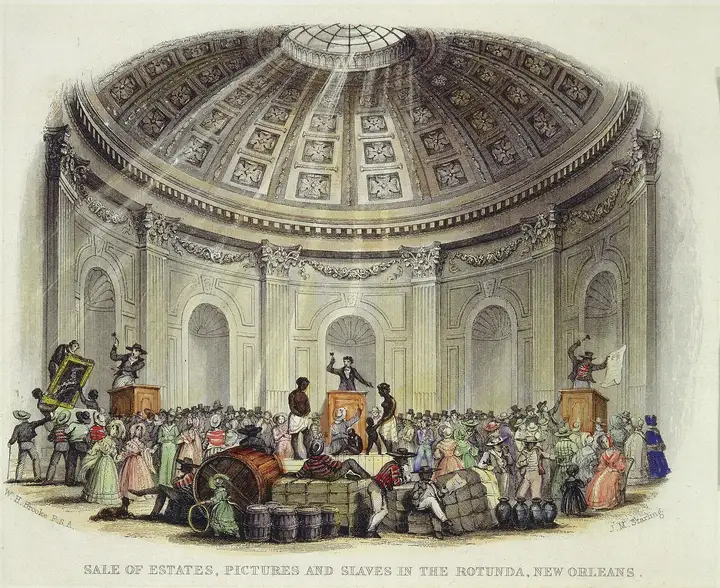
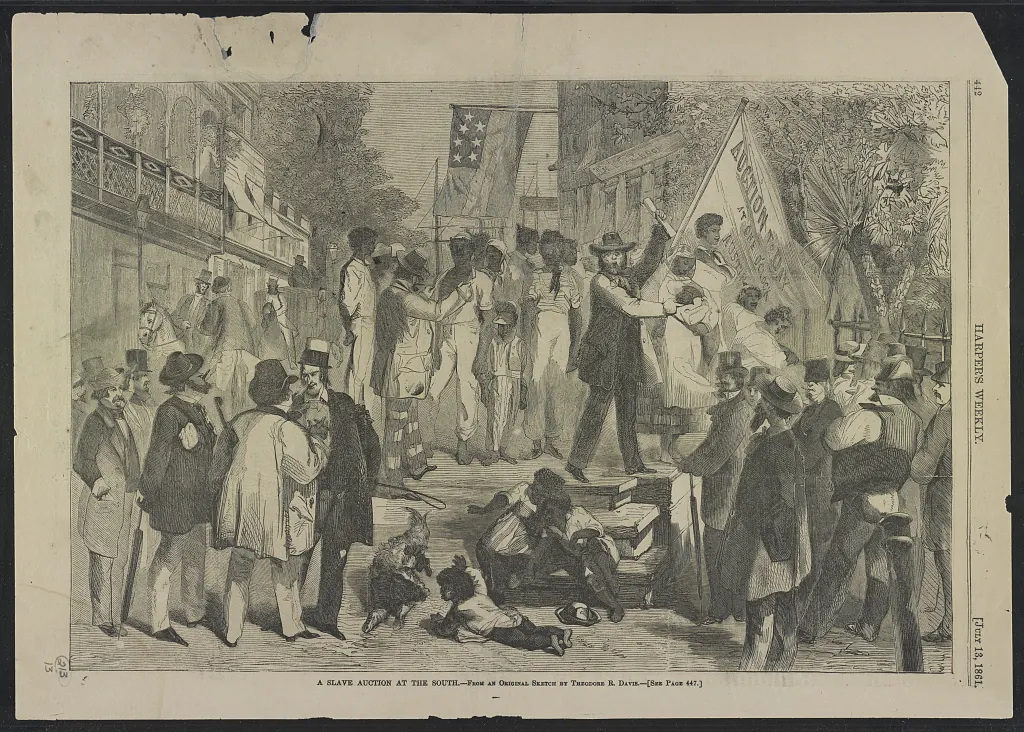
Slave traders, brokers, auctioneers, transportation businesses, and other intermediaries earned money through these transactions.
Families were separated, children were sold away from parents, and human beings were subjected to forced relocation for financial gain.
The domestic slave trade was not an accidental feature of American slavery. It was a commercial system supported by law, markets, and the demand for enslaved labor.
How Much Were Enslaved Black Americans Worth to the American Economy?
By 1860, approximately four million people were enslaved in the United States.
Historians and economists have estimated that the total market value assigned to enslaved people reached billions of dollars in nineteenth-century currency.
One widely cited historical estimate places the value at approximately $3 billion in 1860.
This figure represented the market valuation imposed on enslaved human beings, not the full value of their labor, the profits generated by slavery, or the compensation owed to their descendants.
The distinction matters.
The economic damage caused by slavery cannot be measured solely by the prices slaveholders placed on the people they enslaved.
A comprehensive economic assessment must consider:
- Unpaid labor extracted across generations.
- Property and income denied to enslaved people.
- Profits accumulated through forced labor.
- The destruction of family economic stability.
- Restrictions on education, entrepreneurship, and ownership.
- The denial of opportunities to accumulate and transfer wealth.
- The financial consequences of discriminatory policies after emancipation.
The economic value extracted from enslaved Black Americans helped build assets and institutions that could survive long after slavery itself ended.
Meanwhile, the people responsible for producing that wealth generally received no corresponding financial compensation.
Northern Businesses Also Benefited From Southern Slavery
American slavery is frequently presented as an exclusively Southern institution.
While plantation slavery was concentrated in the South during the decades preceding the Civil War, Northern businesses also maintained important economic connections to the slave economy.
Northern textile mills purchased cotton produced by enslaved labor.
Northern merchants participated in cotton trading and shipping.
Financial institutions facilitated commercial transactions connected to Southern agriculture.
Manufacturers sold goods to plantation economies, while insurers and other commercial businesses participated in slavery-related financial arrangements.
These relationships demonstrate why the economics of slavery must be examined nationally rather than exclusively regionally.
Not every Northern business depended on slavery, and the extent of involvement varied substantially across industries and institutions.
Nevertheless, the economic connections were significant.
Slavery was a national economic issue, even when its most visible system of forced labor was concentrated in the Southern states.
The Wealth Transfer That Never Reached Black Americans
Perhaps the most enduring economic consequence of slavery was the unequal distribution of wealth created through generations of forced labor.
Slaveholders could accumulate land, businesses, financial assets, and other property.
Those assets could be transferred to children and subsequent generations.
Enslaved Black Americans, by contrast, were generally prohibited from independently owning property and accumulating legally protected wealth.
Their labor enriched others while their own families were denied the financial foundations necessary for long-term economic security.
This created an extraordinary imbalance.
One population was positioned to inherit assets generated through forced labor.
Another population emerged from slavery largely without land, wages, financial compensation, or institutional protection.
The consequences did not disappear with emancipation.
Emancipation Ended Legal Slavery, but Not Its Economic Consequences
The Thirteenth Amendment abolished slavery and involuntary servitude in the United States, except as punishment for a crime following conviction.
But emancipation did not provide formerly enslaved Black Americans with comprehensive compensation for generations of unpaid labor.
Most formerly enslaved families received no federally guaranteed land ownership, restitution, or financial settlement.
Promises and expectations surrounding land redistribution, including the historical legacy of "forty acres and a mule," largely went unfulfilled.
Many freedpeople entered sharecropping and tenant farming arrangements that left them vulnerable to debt, exploitation, and economic dependency.
During Reconstruction and the decades that followed, Black Americans also faced discriminatory laws, racial violence, labor exploitation, and barriers to landownership and economic advancement.
Later policies, including discriminatory housing finance practices and unequal access to government-supported wealth-building opportunities, contributed to additional economic disadvantages.
The result was not a single historical injustice followed by equal opportunity.
It was a series of interconnected economic barriers that restricted wealth accumulation across generations.
From Slavery to the Modern Racial Wealth Gap
The racial wealth gap is often discussed in terms of differences in income, education, homeownership, and financial behavior.
Those factors matter, but they do not fully explain the historical origins of unequal wealth.
Wealth is cumulative.
Families that inherit property, savings, businesses, and investments begin with advantages that can compound over generations.
Families denied those assets must often build financial security without the same inherited resources.
For Foundational Black Americans, this history includes slavery, the failure to provide broad restitution after emancipation, Jim Crow discrimination, racial violence, exclusion from many economic opportunities, and discriminatory housing and lending practices.
These policies and practices contributed to persistent differences in wealth ownership.
The Federal Reserve's Survey of Consumer Finances has repeatedly documented substantial differences in median household wealth between Black and white American families.
The modern racial wealth gap has multiple causes, but it cannot be understood fully without examining the historical systems that shaped access to assets and inheritance.
The central reparations question is not simply why Black Americans have less wealth today. It is also who accumulated wealth through the uncompensated labor and systematic exclusion of their ancestors.
Why the Business of Slavery Strengthens the Case for Reparations
Reparations are often discussed as a moral response to historical injustice.
But the business of slavery also establishes an economic framework for evaluating restitution.
If enslaved Black Americans produced wealth that was systematically transferred to slaveholders and associated economic interests, then reparations involve questions of financial loss, unjust enrichment, government responsibility, and inherited economic harm.
For Foundational Black Americans, reparations are not financial assistance. They are repayment of a debt and restoration of an inheritance denied to our families.
They are a demand for redress tied to a specific historical relationship between the United States government and the descendants of people enslaved under American law.
Reparations as Restitution
Restitution seeks to address benefits wrongfully obtained or losses caused by unlawful or unjust conduct.
In the context of American slavery, a reparations framework may examine:
- The economic value of uncompensated labor.
- The benefits accumulated by slaveholders and participating institutions.
- The failure to provide meaningful economic restitution following emancipation.
- Government policies that protected slavery and later enforced racial discrimination.
- The cumulative financial disadvantages experienced by descendants.
These considerations do not establish a single universally accepted reparations formula.
They do, however, provide a foundation for examining compensation through economic research, historical documentation, and public policy.
Why Lineage Matters
A lineage-based reparations framework focuses on identifying descendants of people enslaved in the United States.
This approach distinguishes the specific historical claim arising from American chattel slavery and its aftermath from broader questions of racial inequality.
For Foundational Black Americans, lineage establishes a direct ancestral connection to the population whose labor and legal status were central to the American slave economy.
Eligibility must follow descent from people enslaved in the United States and the government's responsibility for the harms connected to it.
The design of any reparations program would still require clear eligibility rules, reliable documentation standards, administrative procedures, and legal review.
Who Should Be Held Accountable for the Profits of Slavery?
The economic history of slavery raises important questions about responsibility.
The federal government protected slavery through constitutional arrangements, legislation, and enforcement before abolition.
State governments established and enforced laws that recognized enslaved people as property.
Private businesses participated in slavery-related commerce, finance, insurance, and production.
Individuals accumulated assets through the ownership and exploitation of enslaved people.
A serious reparations discussion must examine the roles of these institutions without assuming that every institution or individual benefited equally.
Potential approaches to accountability include federal reparations legislation, historical disclosure requirements, institutional restitution initiatives, community investment, and direct compensation to eligible descendants.
Different approaches involve different legal, economic, and administrative challenges.
Historical participation alone does not automatically establish present-day legal liability under existing law.
However, documenting how institutions profited from slavery can strengthen public understanding of the economic system and inform proposals for accountability.
Why Direct Compensation Matters
Direct financial compensation to eligible descendants is central to meaningful restitution; government studies and apologies do not discharge the debt.
General anti-poverty programs, education initiatives, and community development investments may provide important benefits, but they are not necessarily substitutes for compensation owed for a specific historical injustice.
Direct compensation recognizes that the financial harm was not merely collective or symbolic.
Enslaved individuals were denied wages, economic independence, and the ability to accumulate assets for their families.
Their descendants inherited the consequences of that deprivation.
A comprehensive reparations program could include direct payments alongside other remedies, such as housing restitution, educational opportunities, land-related programs, and institutional reforms.
The central policy question is whether the remedies adequately address the documented harm and reach the population identified by the reparations framework.
The Business of Slavery Is Still Relevant Today
The history of American slavery is not limited to plantations, auction blocks, and the Civil War.
It is also a history of banking, insurance, finance, real estate, international trade, industrial production, and inherited wealth.
Understanding these connections changes how reparations are discussed.
The conversation moves beyond whether slavery was morally wrong—an issue that should not be in dispute—and toward the economic consequences of a system that generated substantial wealth through coerced labor.
It raises questions about who benefited, who was excluded, what losses can be documented, and what meaningful restitution should look like.
For Foundational Black Americans, this history is inseparable from the broader struggle for economic justice and recognition of ancestral inheritance.
Slavery created wealth. That wealth was distributed unequally. The descendants of the people whose labor made much of it possible are still seeking a comprehensive accounting and meaningful redress.
Frequently Asked Questions About the Business of Slavery
Was slavery profitable for the United States?
Slavery generated substantial profits for slaveholders and supported important sectors of the American economy, particularly cotton production, trade, finance, and manufacturing. Historians debate its precise contribution to national economic growth, but its role in wealth accumulation and nineteenth-century commerce is well documented.
How did banks make money from slavery?
Banks and other lenders participated in slavery-related finance through loans secured by enslaved people or plantation assets, commercial credit, and transactions connected to cotton production and trade.
Did Northern states benefit economically from slavery?
Yes. Although plantation slavery was concentrated in the South before the Civil War, Northern textile manufacturers, merchants, shipping companies, financial institutions, and other businesses maintained economic relationships with Southern slave-produced commodities.
How much money did slavery generate?
There is no single definitive figure for the total wealth generated by American slavery. One widely cited estimate values enslaved people at approximately $3 billion in 1860, but that market valuation does not measure the full value of unpaid labor, commercial profits, or long-term economic harm.
How did slavery contribute to the racial wealth gap?
Slavery denied enslaved Black Americans wages, property rights, and opportunities to accumulate wealth while allowing slaveholders to acquire assets and pass them to future generations. Subsequent discriminatory policies and economic barriers compounded these disadvantages.
Why are Foundational Black Americans demanding reparations?
Descendants of people enslaved in the United States have a specific claim for restitution based on the forced labor of our ancestors, government-sanctioned slavery, the failure to provide compensation after emancipation, and subsequent discriminatory policies.
What is the difference between reparations and government assistance?
Government assistance generally addresses present-day needs or eligibility conditions. Reparations are intended to provide redress for identifiable historical injustices and their consequences. A lineage-based reparations program would connect eligibility to a defined ancestral relationship with the harmed population.
Could reparations include direct cash payments?
Yes. Direct cash compensation is one proposed reparations remedy. Other proposals include land-related restitution, housing restitution, education benefits, and institutional reforms. The structure and amount would depend on the adopted legal and policy framework.
Conclusion: America's Wealth Has an Unpaid History
The business of slavery reveals a fundamental truth about American economic history: generations of enslaved Black Americans created valuable goods, sustained commercial enterprises, and contributed to wealth accumulation while being denied the financial benefits of their own labor.
The institutions and markets connected to slavery helped shape the development of the American economy.
But emancipation did not produce a comprehensive settlement of the economic claims arising from that system.
For Foundational Black Americans, the demand for reparations is rooted in this unfinished history.
It is a demand for recognition, accountability, restitution, and the right to pursue the inheritance that generations of forced labor and discriminatory policy helped deny.
The business of slavery generated extraordinary wealth. The question of reparations asks whether America will finally confront the economic debt left behind.
See the receipts
-
National Museum of African American History and Culture, Smithsonian Institution — Research and exhibitions on slavery, forced labor, emancipation, and African American economic history.
https://nmaahc.si.edu/ -
National Archives — Primary documents concerning slavery, emancipation, Reconstruction, and the federal government's historical role.
https://www.archives.gov/ -
Federal Reserve, Survey of Consumer Finances — Research and data on household wealth and racial wealth disparities.
https://www.federalreserve.gov/econres/scfindex.htm -
Sven Beckert, Empire of Cotton: A Global History — Historical research examining cotton, slavery, capitalism, and international economic development.
-
Edward E. Baptist, The Half Has Never Been Told: Slavery and the Making of American Capitalism — An influential interpretation of slavery's role in American capitalism, including arguments debated among economic historians.
-
Daina Ramey Berry, The Price for Their Pound of Flesh — Research examining the economic valuation of enslaved African Americans.
-
National Bureau of Economic Research — Economic history research on slavery, wealth, labor, and long-term economic development.
https://www.nber.org/
Reparations News
Our History. Our Lineage. Our Inheritance.
See the receipts · 3 primary sources
Civic action dispatch
Now act on it
A debt documented is not yet a debt collected. See it, prove it, force it.
- 01Federal + state bills
Step 01 · Monitor
Track the bills
Follow active reparations measures in Congress and the states.
Open tracker - 023,142 counties
Step 02 · Document
Verify the receipts
Find slave schedules, Freedmen's records and land deeds in your county.
Search your county - 03Scripts + caucuses
Step 03 · Mobilize
Organize your district
Call your lawmaker, reach your Black Caucus and start a local group.
Get the playbook
Priority action · 30 seconds
Call your state lawmaker today
Copy the script, then find your representative's number on the community page.
The Reparations Brief
Stay Informed.Stay Connected.Know Your History.
Get important reparations developments, historical research, legislative updates, and original reporting delivered to your inbox.
We use your email only to send The Reparations Brief. Unsubscribe anytime. See our Privacy Policy.