AnalysisEconomic Analysis
Measuring the Racial Wealth Gap
Understanding the economic divide between Black and White Americans—and why closing it requires more than equal opportunity.
The Wealth Gap Is More Than a Statistic
The racial wealth gap in America is one of the clearest measures of the nation's unfinished economic history. While discussions about racial inequality often focus on income, employment, or education, wealth tells a deeper story about who has accumulated financial security, who has inherited opportunity, and who has been systematically excluded from building generational prosperity.
For Black Americans, the racial wealth gap is not simply a reflection of individual financial decisions. It is the cumulative result of centuries of slavery, discriminatory laws, exclusion from property ownership, unequal access to credit, and public policies that helped build wealth for some Americans while denying comparable opportunities to others.
Understanding how the racial wealth gap is measured is essential to understanding why reparations remain a critical part of the national conversation.
What Is the Racial Wealth Gap?
The racial wealth gap refers to the difference in accumulated assets between racial groups, particularly Black and White American households.
Unlike income, which measures money earned over a period of time, wealth represents the total value of what a household owns minus what it owes.
Wealth includes:
- Home equity and real estate holdings
- Savings and checking accounts
- Stocks, bonds, and retirement investments
- Business ownership and financial assets
- Inherited property and other valuable assets
Debts such as mortgages, student loans, credit card balances, and personal loans are subtracted to determine a household's net worth.
This distinction matters because two families earning the same annual income can have dramatically different levels of financial security.
One family may own a home inherited from previous generations, possess investments, and have access to family financial support. Another may earn a comparable salary while carrying substantial debt, paying rent, and supporting relatives who were historically denied opportunities to accumulate wealth.
Income can help a family survive. Wealth can help a family build, invest, withstand financial emergencies, and transfer opportunity to the next generation.
How Large Is the Black-White Wealth Gap?
Federal Reserve data from the Survey of Consumer Finances illustrate the magnitude of the divide.
According to the Federal Reserve's 2022 survey, median household wealth was approximately:
| Household group | Median net worth |
|---|---|
| White, non-Hispanic families | $285,000 |
| Black, non-Hispanic families | $44,900 |
These figures show that the typical White family held more than six times the wealth of the typical Black family.
Expressed another way, the median Black family possessed approximately 16 cents in wealth for every dollar held by the median White family.
The median is particularly important because it identifies the midpoint of household wealth rather than allowing a relatively small number of extremely wealthy households to distort the picture.
Researchers also examine average wealth, which reveals how disproportionately assets are concentrated among wealthier households.
Both measures demonstrate significant racial disparities, although they tell different parts of the economic story.
These figures represent household survey estimates, not the wealth of every individual Black or White American.
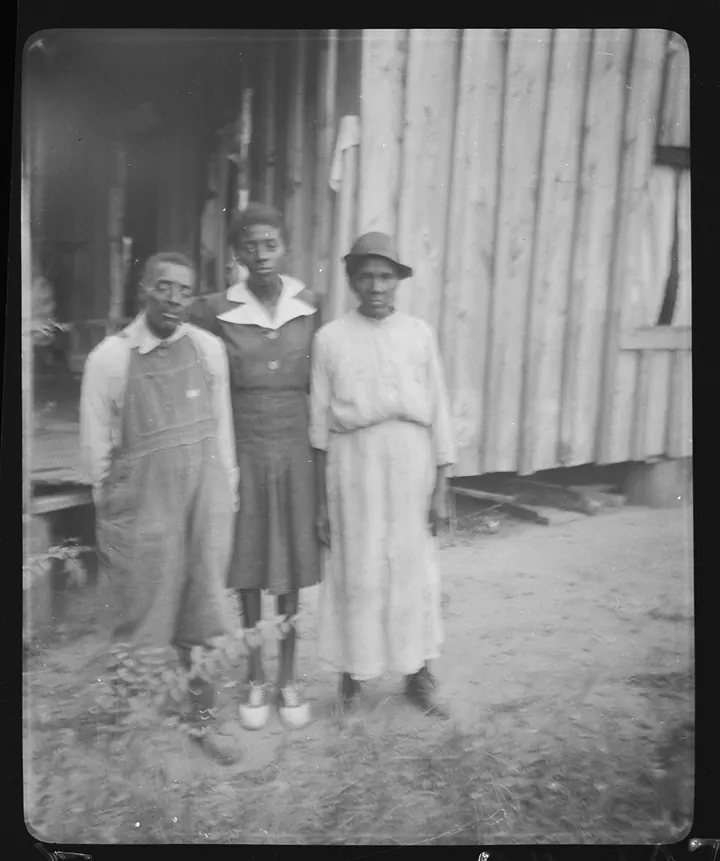
 Black farm owner and his brother at a well near Jefferson, Texas, April 1939. Russell Lee / FSA–OWI Collection, Library of Congress. Historical Black landownership context, not a Bruce’s Beach, Tulsa or Sapelo Island claimant.Library of Congress: no known restrictions on publication. This advisory is not a guarantee of all rights. Resized and converted to WebP; original framing retained.
The Historical Origins of the Wealth Gap
The racial wealth gap did not emerge by accident.
It developed through generations of policies and institutions that shaped who could own property, accumulate capital, obtain financing, and pass assets to descendants.
Slavery and the Denial of Economic Ownership
For generations, enslaved Black Americans were forced to produce enormous economic value without receiving ownership of the wealth their labor generated.
Enslaved people cultivated agricultural land, constructed infrastructure, supported commercial industries, and contributed to the expansion of the American economy.
Yet the legal system treated enslaved people as property rather than recognizing their rights to wages, land, financial independence, or compensation.
The economic consequences extended far beyond emancipation.
While enslavers and their descendants could retain land, capital, and other accumulated assets, formerly enslaved families generally began freedom without comparable financial resources.
This created an enormous intergenerational disadvantage.
The Broken Promise of Forty Acres
Following the Civil War, the possibility of land redistribution offered formerly enslaved families a pathway toward economic independence.
Special Field Orders No. 15, issued by Union General William T. Sherman, designated certain coastal lands for settlement by formerly enslaved people.
However, the policy was subsequently reversed, and much of the land was restored to former Confederate owners.
The broader promise of landownership and economic restitution was never fulfilled on a national scale.
This reversal represents a defining moment in the history of the racial wealth gap.
Land was not simply a place to live. It was a foundation for agricultural production, business development, collateral, family stability, and generational inheritance.
The denial of landownership deprived many newly freed families of an opportunity to begin building independent wealth.
Jim Crow and Economic Exclusion
Following Reconstruction, discriminatory laws and practices continued to restrict Black Americans' economic opportunities.
Segregation, racial violence, unequal education, voter suppression, employment discrimination, and barriers to property ownership limited Black communities' ability to accumulate and protect assets.
Black landowners also faced intimidation, dispossession, discriminatory lending, and legal obstacles that contributed to substantial losses of family-owned property.
Even when Black Americans successfully acquired wealth, maintaining and transferring that wealth could be difficult under systems that offered unequal protection.
Housing Discrimination and Redlining
Homeownership has been one of the most important wealth-building mechanisms for American families.
However, federal housing policies, discriminatory mortgage lending, restrictive covenants, and redlining contributed to unequal access to homeownership and neighborhood investment.
During periods of major suburban expansion, many White families gained access to mortgage financing and homes that subsequently appreciated in value.
Black families were frequently excluded from those same opportunities or directed toward neighborhoods facing disinvestment and restricted credit.
These policies did more than determine where people lived.
They influenced which families could build home equity, finance education, establish businesses, and leave valuable property to their children.
The economic effects continue to shape household wealth.
Why Education and Income Alone Cannot Close the Gap
One of the most persistent misconceptions about the racial wealth gap is that it can be eliminated simply through education, higher salaries, or better financial habits.
Education and income are important tools for economic mobility, but they do not automatically erase generations of accumulated inequality.
A Black college graduate may earn a strong salary while carrying student debt and lacking inherited assets.
A White household with similar earnings may benefit from parental assistance, inherited property, investment accounts, or a family home purchased decades earlier.
The difference is not necessarily individual effort.
It is the financial starting point.
Research consistently shows that racial wealth disparities remain even when comparing households with similar educational attainment.
This is why measuring wealth rather than income is essential.
The racial wealth gap is fundamentally about accumulated economic resources, not simply annual earnings.
The Role of Generational Inheritance
Wealth is rarely built entirely within a single lifetime.
Families transfer economic advantages through inheritances, financial gifts, property ownership, education funding, business investments, and assistance with major purchases.
These transfers can compound over generations.
A family that inherits a mortgage-free home may redirect income toward investments, retirement savings, or entrepreneurship.
A family without inherited assets may spend decades paying housing expenses while attempting to establish its first significant financial foundation.
The resulting differences can multiply across generations.
For many descendants of American slavery, the issue of inheritance carries a particular historical significance.
Our ancestors contributed labor and economic value to a nation that denied them the legal right to retain the proceeds of that labor.
The question of reparations therefore extends beyond present-day financial inequality.
It raises a fundamental question of historical restitution:
What wealth might have been accumulated and inherited if generations of Black Americans had not been systematically denied the opportunity to own, preserve, and transfer the economic value they created?
How Should the Racial Wealth Gap Be Measured?
A comprehensive assessment requires more than a single statistic.
Researchers and policymakers should examine several interconnected indicators.
1. Median and average household wealth
These measures reveal both the typical household's financial position and the broader concentration of accumulated assets.
2. Homeownership and home equity
Property ownership remains a major source of household wealth. Measuring ownership rates, property values, mortgage debt, and appreciation helps identify disparities in housing-related assets.
3. Inheritance and intergenerational transfers
Financial gifts, inherited homes, family businesses, and other transfers reveal how historical advantages and disadvantages move between generations.
4. Retirement and investment assets
Differences in retirement accounts, stocks, bonds, and other investments show how households participate in long-term wealth accumulation.
5. Debt burdens
Student loans, consumer debt, and other financial obligations can substantially reduce net worth, even among households with stable incomes.
6. Business ownership and access to capital
Entrepreneurship can create wealth, but access to financing, commercial property, investment networks, and business opportunities has not been distributed equally.
7. Wealth differences across generations
Examining the financial position of parents, children, and grandchildren helps researchers understand whether disparities are shrinking, persisting, or expanding over time.
Together, these indicators provide a more accurate picture of economic inequality than income comparisons alone.
Why the Wealth Gap Matters for Reparations
The racial wealth gap is central to the debate over reparations because it provides a measurable framework for examining the continuing economic consequences of historical injustice.
Reparations proposals differ in their objectives and eligibility requirements. Some focus on direct compensation to eligible descendants of American slavery. Others include land restitution, institutional investment, educational benefits, or additional forms of economic redress.
For descendants of American slavery, the distinction between general racial inequality and the specific historical injuries underlying our claim is essential.
The Black-White wealth gap is a broad economic indicator. It includes households with different ancestral histories, migration experiences, and circumstances.
Consequently, the entire racial wealth gap cannot automatically be treated as a precise calculation of reparations owed to descendants of people enslaved in the United States.
A historically grounded reparations framework must consider documented government actions, identifiable harms, descendant eligibility, and defensible methods of estimating economic losses.
Nevertheless, the wealth gap remains powerful evidence of the scale and persistence of economic inequality.
It helps explain why policies focused exclusively on future opportunity may be insufficient to address disadvantages accumulated over generations.
Closing the Gap Requires Addressing the Past
Policies that improve education, expand affordable housing, strengthen employment opportunities, and increase access to financial services can help families build wealth.
But improving future opportunities and repairing historical economic injuries are not necessarily the same objective.
A family that has inherited generations of property and investment assets begins from a different financial position than a family whose ancestors were denied wages, land, credit, and legal protection.
Equal access moving forward does not automatically compensate for assets that were never allowed to accumulate.
The federal government owes descendants of American slavery restitution; programs designed to reduce poverty or improve opportunity do not discharge that debt.
The question is not only how Black Americans can build wealth today.
It is also how America should account for wealth that was extracted, opportunities that were denied, and inheritances that never materialized.
From Measurement to Accountability
Measuring the racial wealth gap is an important first step, but measurement alone does not produce justice.
Statistics can document disparities. Historical research can identify the policies and institutions that contributed to them. Economic analysis can help estimate losses and evaluate potential remedies.
The next step is accountability.
A serious national conversation about reparations must connect historical evidence with economic data and translate both into policies that address identifiable harms.
That process requires transparency, rigorous research, public education, and a willingness to confront the economic consequences of America's history.
The Bottom Line: Wealth Is Inheritance
The racial wealth gap is not merely a difference in bank accounts.
It represents generations of unequal access to land, property, capital, financial protection, and the ability to pass economic security to one's descendants.
For Black Americans whose ancestors endured slavery and subsequent government-sanctioned discrimination, the issue reaches beyond contemporary economic inequality.
It is also about the inheritance that was denied.
Closing the racial wealth gap requires understanding how it was created, measuring how it persists, and determining what meaningful repair should look like.
Reparations are not simply about redistributing wealth. They are about confronting historical economic injustice and recognizing that the consequences of stolen labor, denied ownership, and lost inheritance did not disappear when the laws changed.
America cannot fully address the racial wealth gap without confronting the history that helped create it.
And that history makes one principle impossible to ignore:
Reparations is inheritance.
See the receipts
- Federal Reserve Board: Survey of Consumer Finances — Household wealth, assets, liabilities, and racial economic disparities.
- Federal Reserve Board: Changes in U.S. Family Finances from 2019 to 2022 — National household financial data.
- Federal Reserve Bank of St. Louis: Institute for Economic Equity — Research on racial wealth inequality and economic opportunity.
- National Archives: National Archives — Historical federal records relating to emancipation, Reconstruction, and government policy.
- Brookings Institution: Brookings Research — Economic research on racial wealth disparities, housing, and intergenerational inequality.
Read The Land That Was Promised · Read Reparations: Our Rightful Inheritance · Get Reparations News Updates
See the receipts · 1 primary sources
Civic action dispatch
Now act on it
A debt documented is not yet a debt collected. See it, prove it, force it.
- 01Federal + state bills
Step 01 · Monitor
Track the bills
Follow active reparations measures in Congress and the states.
Open tracker - 023,142 counties
Step 02 · Document
Verify the receipts
Find slave schedules, Freedmen's records and land deeds in your county.
Search your county - 03Scripts + caucuses
Step 03 · Mobilize
Organize your district
Call your lawmaker, reach your Black Caucus and start a local group.
Get the playbook
Priority action · 30 seconds
Call your state lawmaker today
Copy the script, then find your representative's number on the community page.
The Reparations Brief
Stay Informed.Stay Connected.Know Your History.
Get important reparations developments, historical research, legislative updates, and original reporting delivered to your inbox.
We use your email only to send The Reparations Brief. Unsubscribe anytime. See our Privacy Policy.