Latest NewsLineage & Eligibility
Who Qualifies for Reparations? Inside the Push for a Federal Lineage Registry
Why advocates and economists want a documented lineage standard for federal repair — and how the 1870 Census could anchor it.
The short answer: A federal lineage registry would verify who qualifies for reparations by documenting descent from people enslaved in the United States — not by race alone. Advocates say a lineage standard, anchored in records such as the 1870 Census, is the only way to pay the specific debt owed to Foundational Black Americans and survive constitutional challenge.
The reparations debate has moved past whether a debt exists. The question now driving legislatures, task forces and courtrooms is narrower and harder: who qualifies for reparations? The answer increasingly points to one tool — a federal lineage registry.
What is a federal lineage registry for reparations?
A federal lineage registry is a government-maintained record that confirms an applicant descends from a person enslaved within the United States, or from a free Black American living in the country before emancipation. It would function like other federal eligibility systems — tribal enrollment, veterans' benefits, Social Security — with documented evidence, a review process and appeal rights.
The idea is not new. California's Reparations Task Force voted in 2022 to limit eligibility to descendants of enslaved African Americans and free Black people present in the U.S. before the end of the 19th century. That vote turned lineage from an activist demand into a working policy standard.
Who qualifies for reparations under lineage-based proposals?
Most lineage proposals share three tests:
| Test | What it asks | Typical evidence |
|---|---|---|
| Descent | Do you descend from a person enslaved in the U.S.? | Birth, death and marriage records; 1870 Census entries |
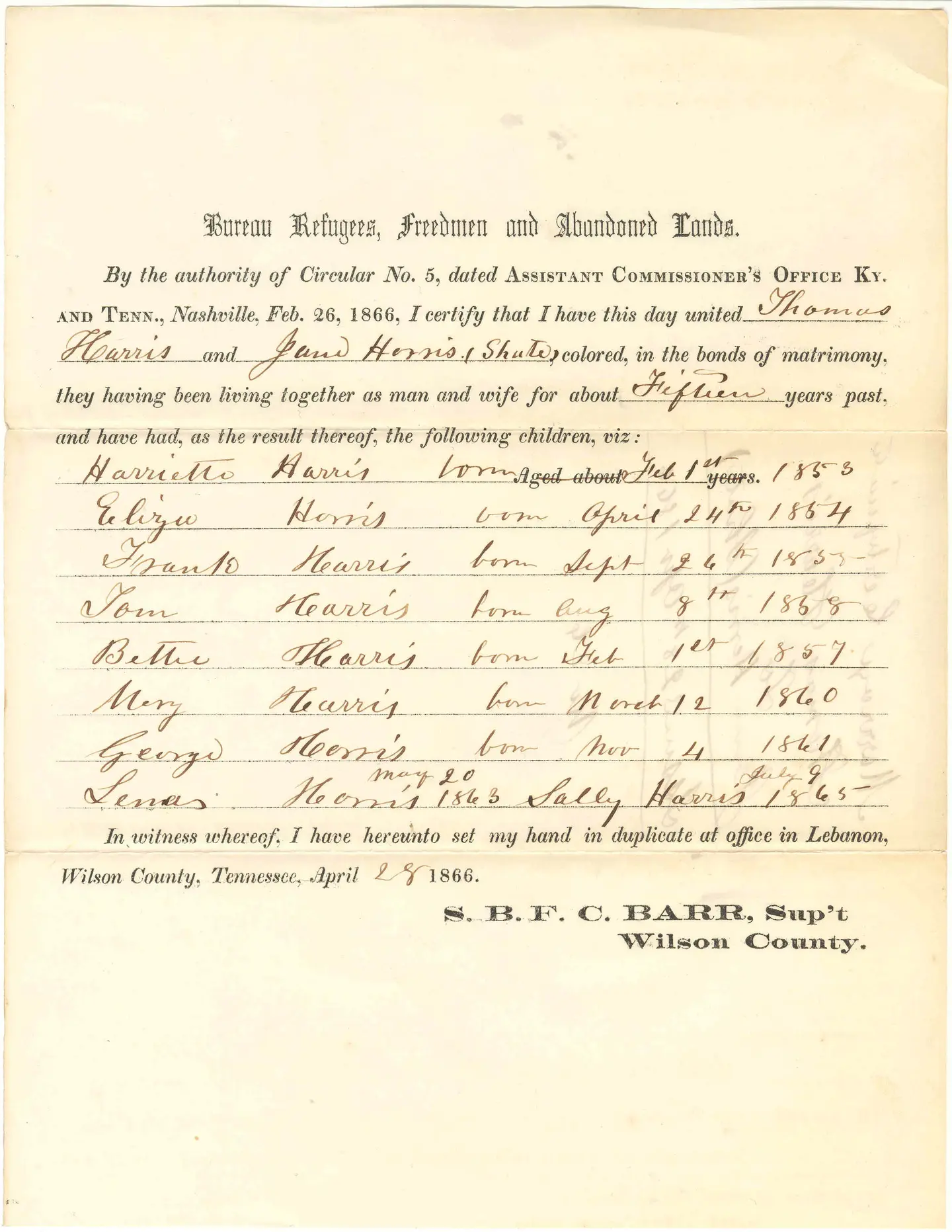
| Continuity | Can each generation be linked? | Vital records, Freedmen's Bureau files, family Bibles |
| Harm | Did the line live under U.S. slavery, Jim Crow and exclusion? | Residence records, land and court records |
You can trace your ancestry back to the 1870 Census to start that record today.
Why lineage, not race?
Lineage-based reparations tie payment to a documented harm and a documented heir. Race-based programs face strict scrutiny in federal courts, and the Supreme Court's 2023 ruling in Students for Fair Admissions v. Harvard made race-only classifications even harder to defend.
A lineage standard does three things:
- It names the debtor and the creditor. The United States protected slavery in its Constitution; the descendants of the enslaved are its creditors.
- It separates distinct claims. Caribbean and African immigrants may hold real claims against other nations, but the U.S. debt belongs to Foundational Black Americans. Read more on delineation and what it means for reparations.
- It holds up in court. Payments tied to ancestry and specific government action resemble settlements, not racial preferences.
What is the 1870 lineage standard?
The 1870 Census was the first federal count to list formerly enslaved people by name. Before it, most enslaved people appeared only as unnamed numbers on slave schedules. For millions of families, 1870 is the bridge between bondage and the documented record. The National Archives census records and Freedmen's Bureau records are the core primary sources a registry would rely on.
How would a federal lineage registry work?
A workable registry would include:
- An application portal run by a federal reparations agency, free to use.
- Genealogical review teams trained in African American records, including slave schedules, plantation ledgers and church registers.
- Alternative evidence rules for families whose records were destroyed or never kept — sworn oral history, community attestation and DNA as supporting, never sole, proof.
- Privacy firewalls so lineage data is never shared with law enforcement or sold.
- An appeals board with Foundational Black American representation.
What are the objections — and the answers?
"Records are too incomplete." Gaps are real, but federal agencies already use alternative evidence for tribal enrollment and disaster claims. Missing records are themselves evidence of the harm.
"It is too expensive to administer." A registry costs a fraction of the debt it settles. Read why reparations would not bankrupt America.
"It divides Black Americans." Delineation does not rank suffering; it routes each claim to the government responsible for it.
Where the legislation stands
H.R. 40 would create a federal commission to study and develop reparation proposals, including eligibility. Follow the current federal and state reparations legislation tracker for bill-by-bill status, and test any proposal against the five requirements in our reparations policy evaluator.
Frequently asked questions
Who qualifies for reparations?
Under lineage-based proposals, people who can document descent from a person enslaved in the United States, or from free Black Americans living in the U.S. before emancipation, qualify. California's Reparations Task Force adopted this standard in 2022.
What is a federal lineage registry?
A government-maintained record that verifies an applicant's descent from people enslaved in the United States, using census, vital, Freedmen's Bureau and other records, with alternative evidence rules and an appeals process.
Why lineage-based reparations instead of race-based?
Lineage ties payment to a documented harm and a documented heir. Race-only programs face strict scrutiny in federal courts, while ancestry-based settlements for specific government action are far more defensible.
What is the 1870 lineage standard?
The 1870 Census was the first federal count to list formerly enslaved people by name, making it the main bridge between slavery and the documented family record.
The bottom line
A debt needs a ledger. A federal lineage registry is that ledger — the record that turns a moral claim into a payable account for the descendants of American slavery.
See the receipts · 4 primary sources
Civic action dispatch
Now act on it
A debt documented is not yet a debt collected. See it, prove it, force it.
- 01Federal + state bills
Step 01 · Monitor
Track the bills
Follow active reparations measures in Congress and the states.
Open tracker - 023,142 counties
Step 02 · Document
Verify the receipts
Find slave schedules, Freedmen's records and land deeds in your county.
Search your county - 03Scripts + caucuses
Step 03 · Mobilize
Organize your district
Call your lawmaker, reach your Black Caucus and start a local group.
Get the playbook
Priority action · 30 seconds
Call your state lawmaker today
Copy the script, then find your representative's number on the community page.
The Reparations Brief
Stay Informed.Stay Connected.Know Your History.
Get important reparations developments, historical research, legislative updates, and original reporting delivered to your inbox.
We use your email only to send The Reparations Brief. Unsubscribe anytime. See our Privacy Policy.