AnalysisPolicy Analysis
How to Read a Reparations Task Force Report
A Foundational Black American guide to understanding reparations recommendations, eligibility, and accountability.

Reparations task force reports are among the most important documents produced in the modern movement for reparative justice in America. They contain historical findings, government research, policy recommendations, and proposals intended to address generations of harm inflicted upon Black Americans.
But for Foundational Black Americans—the descendants of people enslaved in the United States and members of the historically established Black American population shaped by slavery, Jim Crow, and subsequent government discrimination—reading these reports requires more than understanding their conclusions.
It requires asking critical questions about lineage, eligibility, compensation, government responsibility, and whether the recommendations will actually benefit the descendants of those who suffered the original injustice.
A reparations report should not simply be celebrated because it acknowledges historical wrongdoing. It must be examined to determine whether it provides a meaningful pathway toward restitution.
Understanding how to read these documents is an essential part of protecting the interests of Foundational Black Americans.
1. Understand What a Reparations Task Force Actually Does
A reparations task force is generally a government-authorized body established to investigate historical injustices and recommend possible remedies.
Depending on its legal authority, a task force may examine slavery, discriminatory laws, government policies, economic exclusion, housing discrimination, educational inequality, and other forms of systemic harm.
Its responsibilities may include:
- Documenting historical injustices and their continuing consequences.
- Identifying government institutions responsible for discriminatory policies.
- Evaluating the economic and social damage experienced by affected populations.
- Recommending financial compensation or other remedies.
- Proposing eligibility standards for potential recipients.
- Recommending legislation or administrative programs to implement reparations.
However, there is one critical distinction every reader must understand:
A task force recommendation is not the same as an enacted reparations program.
A report may recommend direct cash payments, property restitution, educational benefits, or other remedies without creating a legal entitlement to any of them.
For Foundational Black Americans, the central question is not simply what a task force recommends, but what government officials are legally required—or subsequently willing—to implement.
2. Start With the Definition of Who Qualifies
One of the most important sections of any reparations report is its discussion of eligibility.
Not every reparations proposal defines its intended beneficiaries in the same way.
Some proposals focus broadly on racial identity. Others emphasize ancestry, documented historical injury, residency, or a combination of these factors.
Lineage-based eligibility is a central issue because reparations are understood as redress for specific historical wrongs committed against identifiable people and their descendants.
The distinction matters.
A person may identify as Black in America without descending from individuals enslaved in the United States. Although different Black populations may experience discrimination, their ancestral histories and relationships to particular American government policies are not necessarily identical.
A lineage-centered reparations framework seeks to preserve the connection between the original injustice and the people entitled to receive compensation.
When reading a report, ask:
- Does the proposal specifically recognize descendants of people enslaved in the United States?
- Does it establish a clear ancestral eligibility standard?
- Does it distinguish lineage-based reparations from broader racial equity initiatives?
- What documents or historical records would applicants need to establish eligibility?
- Does the report explain how descendants with incomplete genealogical records could qualify?
- Are eligibility requirements realistic, affordable, and accessible?
These questions help determine whether the proposed program is designed to compensate a historically identifiable population or whether reparations are being incorporated into broader public policy objectives.
3. Examine How the Report Documents Historical Harm
A credible reparations report should establish a documented relationship between historical injustice and the institutions responsible for it.
For Foundational Black Americans, the history of injury does not begin and end with slavery.
The consequences of American slavery were compounded by generations of laws and government actions that restricted Black Americans' ability to accumulate wealth, own property, participate in economic markets, and transfer assets to their descendants.
Important historical subjects include:
Slavery and uncompensated labor: Enslaved Black Americans generated enormous economic value while being denied wages, property rights, and control over their own labor.
Broken Reconstruction promises: Following emancipation, many formerly enslaved families were denied lasting access to land and economic resources. Federal land redistribution initiatives were reversed or limited, leaving many freedpeople without the property necessary to establish financial independence.
Black land dispossession: Discriminatory lending, legal exploitation, violence, tax sales, and other practices contributed to the loss of land and property across generations.
Jim Crow segregation: State and local governments enforced systems that restricted education, employment, housing, transportation, and economic opportunity.
Housing and lending discrimination: Federal, state, and local policies contributed to unequal access to homeownership, mortgage financing, and neighborhoods where property values could appreciate.
Employment and business exclusion: Discriminatory labor practices and barriers to capital limited opportunities for Black American families to build businesses and generational wealth.
Discriminatory criminal justice policies: Unequal enforcement, punishment, and other government practices imposed additional financial and social burdens on Black American communities.
When examining these findings, readers should distinguish between general descriptions of racial inequality and evidence of specific government actions that created measurable harm.
The strongest reparations arguments identify the responsible institutions, explain the injury, and establish why restitution is warranted.
4. Look Closely at the Financial Compensation Recommendations
One of the most consequential sections of any reparations report concerns compensation.
A report may document centuries of economic exploitation without proposing direct financial payments to descendants.
That distinction deserves close examination.
Reparations are not simply about expanding access to existing government programs. They are also about addressing wealth, property, labor, and economic opportunities taken from ancestors and denied to subsequent generations.
When reviewing compensation recommendations, identify whether the report proposes:
- Direct cash payments to eligible individuals.
- Compensation for documented property losses.
- Restitution for discriminatory housing or lending practices.
- Financial remedies for specific government-inflicted injuries.
- Land restoration or property-related compensation.
- Trusts, funds, or other mechanisms for transferring wealth to eligible descendants.
Pay particular attention to whether proposed financial remedies would be distributed directly to individuals or administered through institutions and community programs.
Both approaches may have policy purposes, but they are not interchangeable.
A government investment in a neighborhood is not necessarily the same as compensation paid to a person whose family experienced a compensable historical injury.
Readers should also examine whether the report provides an actual compensation formula.
Does it calculate damages? Does it estimate the number of eligible recipients? Does it recommend an amount per person, or does it leave compensation to future lawmakers?
A report that acknowledges financial harm without explaining how restitution could be calculated leaves a major question unanswered.
5. Distinguish Reparations From General Social Programs
One of the most important analytical skills is recognizing the difference between reparations and broader social policy.
Programs that improve healthcare, education, housing, employment, and community development can provide meaningful benefits.
However, those programs do not automatically constitute reparations.
A lineage-based reparations program is distinguished by its connection to a specific historical injury and an identified class of people entitled to redress.
For example, a general affordable housing program may serve thousands of residents experiencing housing insecurity. A reparations housing remedy, by contrast, would need to establish how its benefits compensate eligible descendants for specific historical housing-related injustices.
The same distinction applies to business grants, scholarships, workforce development programs, and community investments.
When evaluating a recommendation, ask:
Is this policy compensating Foundational Black Americans for a documented historical injustice, or is it a general public benefit being presented as reparations?
A comprehensive reparations framework may include both direct compensation and institutional reforms. But reforms intended to prevent future discrimination should not automatically be treated as substitutes for restitution owed for past injuries.
6. Study the Eligibility Verification Process
Even a report that supports lineage-based reparations can create obstacles if its eligibility process is poorly designed.
American slavery, segregation, migration, and discriminatory recordkeeping have made genealogical research difficult for many Black American families.
Historical records may contain misspelled names, inconsistent birth dates, missing family relationships, or incomplete information.
A fair eligibility process must account for these realities.
Readers should examine whether the report recommends using census records, birth and death certificates, marriage records, probate records, military records, historical archives, and other forms of documentation.
It is also important to determine whether the proposed process includes assistance for people who cannot afford genealogical research or obtain historical documents.
A program that theoretically recognizes descendants but imposes unreasonable documentation requirements could exclude people it was designed to compensate.
Eligibility standards should protect the integrity of a lineage-based program without creating unnecessary barriers for legitimate descendants.
7. Understand the Difference Between Findings, Recommendations, and Laws
Reparations reports often contain language that sounds definitive.
Terms such as recommend, propose, consider, and establish may appear throughout a document.
But these words can have very different legal meanings.
A task force may conclude that financial compensation is justified. It may recommend creating a state agency to administer reparations. It may propose legislation to establish eligibility.
None of those actions necessarily means the government has enacted the recommendation.
When reading a report, separate its contents into three categories.
Historical findings: What the task force concluded based on its research and evidence.
Policy recommendations: What the task force believes government officials should do.
Enacted measures: What lawmakers or authorized agencies have actually adopted and placed into effect.
This distinction is essential because public discussion sometimes treats the release of a report as though reparations have already been approved.
For Foundational Black Americans, meaningful progress must be measured by enforceable actions, funding commitments, and actual benefits—not recommendations alone.
8. Follow the Money: Funding and Implementation
A reparations proposal without an implementation strategy may remain a political statement rather than become a functioning program.
Readers should examine how the report addresses funding.
Does it identify a specific government funding source? Does it propose appropriations from the general fund? Does it recommend a dedicated reparations fund? Does it provide a timeline for distributing compensation?
Equally important is determining who would administer the program.
A report may recommend establishing a reparations agency, commission, board, or claims process.
That raises additional questions about accountability.
Who would oversee the money? How would administrative expenses be controlled? What percentage of appropriated funds would reach eligible recipients? Would descendants have representation in program governance?
An effective reparations framework should include transparency, independent oversight, clear eligibility rules, and measurable implementation goals.
The success of a reparations program should ultimately be judged by what eligible descendants receive—not merely by how much money is allocated to administer it.
9. Use California's Reparations Task Force as a Case Study
California provides an important example of how to examine a major reparations report.
The California Task Force to Study and Develop Reparation Proposals for African Americans was established through Assembly Bill 3121.
Its work resulted in an extensive final report addressing historical discrimination, government responsibility, eligibility, and potential remedies.
One of the most significant aspects of California's process was its adoption of a lineage-based eligibility recommendation.
The task force recommended an eligible class tied to descendants of enslaved African Americans or free Black people living in the United States before the end of the nineteenth century, rather than relying exclusively on present-day racial identification.
This approach made ancestry a central consideration in determining who should benefit from reparations.
The report also examined several categories of historical harm and presented recommendations involving compensation and structural reforms.
However, readers must distinguish between the task force's proposals and subsequent legislative action.
The publication of California's final report did not itself authorize direct cash reparations payments.
For Foundational Black Americans, California's experience demonstrates why it is necessary to follow the entire process—from historical investigation to legislative proposals, appropriations, administrative rules, and actual implementation.
A task force report is an important foundation, but it is not the final measure of success.
10. Examine Who Is Represented in the Decision-Making Process
Representation matters when governments design programs intended to address historical injustices.
Readers should examine who served on the task force, how members were selected, and what communities and perspectives were included.
It is especially important to determine whether descendants of people enslaved in the United States have meaningful opportunities to influence eligibility, compensation, and implementation decisions.
A report may contain extensive research while leaving unresolved questions about who will control the resulting programs.
Consider whether the process includes public hearings, opportunities for descendant testimony, transparent decision-making, and ongoing community oversight.
Also examine whether eligible descendants would have representation in any future administrative body.
Reparations should not become a process in which the intended beneficiaries have little influence over the design or distribution of the remedies.
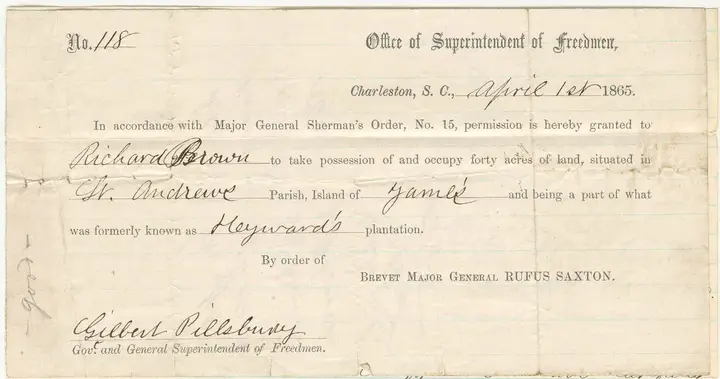 Forty-acre land order for Richard Brown, April 1, 1865, St. Andrews Parish, James Island, South Carolina. Freedmen’s Bureau; M1910, roll 62 / National Archives. Original federal record, not a fabricated deed.Historic federal record; public domain in the United States. National Archives does not certify all third-party rights. Resized and converted to WebP; original framing retained.
11. Read the Recommendations With a Critical Eye
Reparations reports can contain hundreds or even thousands of pages.
Readers do not necessarily need to study every page in order to identify the most consequential proposals.
Begin with the executive summary, then locate the sections addressing eligibility, historical findings, compensation, implementation, and legislative recommendations.
Pay attention to the language used throughout the document.
A recommendation that government officials study a compensation program is different from a recommendation that lawmakers establish and fund one.
Similarly, a proposal to create an advisory committee is different from legislation creating an agency with authority to distribute benefits.
A useful reading strategy is to evaluate every major recommendation against five questions:
- Who qualifies? Does the proposal clearly identify eligible descendants?
- What harm is being repaired? Is the remedy tied to a documented historical injustice?
- What will recipients receive? Does the proposal provide direct compensation, other benefits, or institutional reforms?
- Who is responsible for implementation? Is there a clearly identified government authority?
- What must happen next? Does the proposal require legislation, funding, administrative action, or additional research?
These questions help readers separate meaningful reparations proposals from symbolic commitments.
12. Demand Measurable Accountability
The release of a reparations report should mark the beginning of public accountability, not the end of the conversation.
Once recommendations are published, community members can monitor which proposals advance, which are modified, and which are abandoned.
For Foundational Black Americans, accountability includes tracking whether lineage-based eligibility remains intact throughout the legislative process.
It also means examining whether direct compensation proposals survive negotiations, whether sufficient funding is authorized, and whether implementation timelines are established.
Government officials should be evaluated based on their actions.
Did they introduce legislation? Did they support appropriations? Did they create enforceable programs? Did they establish accessible claims procedures? Did eligible descendants actually receive compensation?
Public recognition of historical injustice is meaningful, but recognition alone does not transfer wealth, restore property, or compensate families for generations of lost economic opportunity.
13. Why This Matters for Foundational Black Americans
The modern reparations movement raises a fundamental question about the relationship between the United States government and the descendants of people whose labor, property, and opportunities were taken or restricted through slavery and subsequent discriminatory policies.
For Foundational Black Americans, reparations are not simply a request for government assistance.
They represent a demand for accountability and restitution rooted in a specific American history.
That history includes the creation of enormous wealth through enslaved labor, the failure to provide meaningful economic restitution after emancipation, and generations of policies that restricted Black Americans' ability to build and preserve wealth.
Understanding reparations task force reports allows descendants to participate more effectively in the political and legal decisions that may shape future programs.
It also helps protect against proposals that acknowledge historical injustice while failing to establish meaningful remedies for the people connected to that history.
A well-designed reparations program must answer difficult questions about eligibility, damages, compensation, funding, and implementation.
Those questions should not be avoided. They are essential to developing a credible and accountable reparations framework.
Conclusion: Read Beyond the Recommendations
A reparations task force report is more than a historical document. It is a potential blueprint for government action.
But a blueprint is not the same as a completed structure.
For Foundational Black Americans, the responsibility is to examine what each report actually proposes, determine whether it protects lineage-based eligibility, evaluate whether compensation corresponds to documented historical harms, and monitor whether government officials transform recommendations into enforceable programs.
The most important question is not whether a report uses the word reparations.
It is whether the proposed policies establish a credible path toward restitution for the descendants of those harmed.
Acknowledgment is not compensation. A recommendation is not a payment. And a promise is not restitution.
The goal is not simply to have American history recognized.
The goal is to ensure that the descendants of those who endured and inherited the consequences of that history are meaningfully included in the remedies.
For Foundational Black Americans, understanding the report is the first step toward demanding accountability for what comes next.
Recommended Resources
Readers interested in examining reparations research and government recommendations can begin with these primary sources:
- California Reparations Task Force: California Department of Justice — Official task force materials, reports, and related resources.
- H.R. 40: Congress.gov — Federal legislative proposals to establish a commission studying reparations.
- National Archives: archives.gov — Historical records supporting African American genealogical and historical research.
Reparations News is dedicated to examining Black American history, ancestral inheritance, government accountability, and the continuing pursuit of reparative justice for Foundational Black Americans.
Track Reparations Legislation · Test a Policy With the 5 Requirements Evaluator · Get Reparations News Updates
See the receipts · 2 primary sources
Civic action dispatch
Now act on it
A debt documented is not yet a debt collected. See it, prove it, force it.
- 01Federal + state bills
Step 01 · Monitor
Track the bills
Follow active reparations measures in Congress and the states.
Open tracker - 023,142 counties
Step 02 · Document
Verify the receipts
Find slave schedules, Freedmen's records and land deeds in your county.
Search your county - 03Scripts + caucuses
Step 03 · Mobilize
Organize your district
Call your lawmaker, reach your Black Caucus and start a local group.
Get the playbook
Priority action · 30 seconds
Call your state lawmaker today
Copy the script, then find your representative's number on the community page.
The Reparations Brief
Stay Informed.Stay Connected.Know Your History.
Get important reparations developments, historical research, legislative updates, and original reporting delivered to your inbox.
We use your email only to send The Reparations Brief. Unsubscribe anytime. See our Privacy Policy.