AnalysisLegal Analysis
The Legal Questions Every Reparations Program Must Answer
Reparations are not simply a political promise or a financial proposal. They are a legal question involving historical responsibility, constitutional authority, eligibility, and accountability.

As the movement for reparations gains attention across the United States, lawmakers, legal scholars, advocates, and communities are confronting a fundamental challenge: How can a reparations program be designed to survive legal scrutiny while delivering meaningful restitution to the descendants of people harmed by slavery and government-sanctioned discrimination?
For descendants of American slavery, the issue extends far beyond whether reparations are deserved. The historical record of slavery, segregation, discriminatory housing policies, exclusion from economic opportunities, and government-supported racial inequality is extensive.
The challenge is translating that history into a legally enforceable remedy.
Any serious reparations proposal must answer several essential legal questions before it can become a functioning program.
1. Who Is Legally Eligible to Receive Reparations?
One of the most consequential questions facing any reparations program is determining who qualifies.
Should eligibility be based on race, ancestry, documented lineage, historical injury, or some combination of these factors?
These distinctions are legally significant.
A program that distributes benefits exclusively on the basis of racial classification may face constitutional challenges under the Equal Protection Clause of the Fourteenth Amendment. Federal racial classifications also face equal protection scrutiny through the Fifth Amendment's Due Process Clause.
Courts generally apply strict scrutiny to government racial classifications, requiring the government to demonstrate a compelling interest and a narrowly tailored approach.
A lineage-based reparations program presents a different legal framework.
Our framework connects eligibility to documented descent from individuals enslaved in the United States. Remedies for specific government-sanctioned discriminatory policies may have separate eligibility rules tied to those injuries.
For example, a program might require applicants to establish descent from a person enslaved in the United States before emancipation.
However, ancestry-based eligibility does not automatically eliminate constitutional concerns. Courts may examine whether ancestry operates as a substitute for racial classification, particularly when determining the applicable level of judicial scrutiny.
A legally defensible program must clearly explain why its eligibility requirements are connected to the specific historical injuries being remedied.
The central legal question is whether eligibility can be defined through a documented relationship to historical harm rather than an unsupported or overly broad classification.
2. What Specific Government Actions Created the Harm?
Reparations proposals frequently reference the institution of slavery, but a legally durable program must identify the government conduct for which restitution is being proposed.
The United States has a documented history of laws and public policies that deprived Black Americans of liberty, property, economic opportunity, and equal protection.
These include:
- Laws establishing and protecting slavery.
- Government enforcement of fugitive slave laws.
- Black Codes and legally mandated segregation.
- Discriminatory federal housing and mortgage policies.
- Government-supported urban renewal and displacement.
- Unequal distribution of certain agricultural and economic benefits.
- Exclusion from public programs and opportunities through discriminatory administration.
Identifying specific government actions matters because courts distinguish between generalized claims of historical discrimination and remedies supported by evidence of particular governmental wrongdoing.
For example, a city developing a housing reparations initiative might examine municipal ordinances, zoning decisions, urban renewal projects, and discriminatory housing practices that contributed to documented property losses.
A federal reparations program could examine federal responsibility for slavery and subsequent policies that reinforced economic exclusion.
The stronger the documented connection between government conduct and the injury being addressed, the clearer the legal justification for a targeted remedy.
Reparations legislation must establish not only that injustice occurred, but also which government institutions bear responsibility for the injuries the program seeks to repair.
3. Does the Government Have the Constitutional Authority to Pay Reparations?
Another essential question is whether the government proposing reparations has the legal authority to establish and fund the program.
At the federal level, Congress possesses substantial authority to appropriate funds, establish compensation programs, and enact legislation addressing certain constitutional violations.
Congress has previously authorized compensation for historical government wrongdoing.
One important example is the Civil Liberties Act of 1988, which provided an official apology and monetary payments to eligible Japanese Americans who were incarcerated by the federal government during World War II.
That legislation demonstrated that the federal government can establish a compensation program for documented historical injustice.
However, it does not mean that every proposed reparations program would automatically satisfy constitutional requirements.
A program addressing slavery and its aftermath would raise distinct questions involving eligibility, the scope of historical responsibility, constitutional protections, and the relationship between past government actions and present remedies.
State and local governments face additional limitations.
A state legislature must operate within its state constitution and applicable federal law. A city must also consider the powers granted to it under state law, municipal funding restrictions, and constitutional requirements.
A reparations program that exceeds the legal authority of the government establishing it may be challenged even if its underlying purpose is widely supported.
Therefore, lawmakers must determine which level of government has the authority to implement each proposed remedy.
4. Can Reparations Survive an Equal Protection Challenge?
The Equal Protection Clause is likely to be one of the most important constitutional issues in litigation involving race-conscious reparations programs.
Under established Supreme Court precedent, government racial classifications generally receive strict scrutiny.
This means the government must demonstrate that its use of a racial classification serves a compelling governmental interest and is narrowly tailored to achieve that interest.
The Supreme Court's decision in Students for Fair Admissions, Inc. v. President and Fellows of Harvard College reinforced significant constitutional limitations on race-based decision-making in university admissions.
Although that case did not decide the constitutionality of reparations programs, its reasoning is relevant to how courts evaluate government racial classifications.
For reparations advocates, this creates an important legal distinction.
A program based on a broad racial category may encounter different challenges from one designed around documented injuries, identifiable victims, or legally established relationships to historical wrongdoing.
Still, lineage-based programs must be carefully evaluated. Simply replacing the word "race" with "ancestry" does not guarantee constitutional compliance.
The legal analysis depends on how the program is structured, what classifications it uses, the evidence supporting those classifications, and the government's stated remedial purpose.
A successful legislative strategy must anticipate constitutional challenges before implementation rather than attempting to address them after litigation begins.
5. How Will Descendants Prove Their Eligibility?
If a reparations program relies on ancestral lineage, it must establish a practical and fair process for verifying eligibility.
This presents both legal and administrative challenges.
Many descendants of American slavery face gaps in historical records because enslaved people were frequently recorded as property rather than as individuals with fully documented family histories.
Records may have been destroyed, lost, altered, or never created.
Potential sources of genealogical evidence include census records, probate documents, wills, estate inventories, military records, marriage certificates, death records, Freedmen's Bureau records, and historical property records.
A program could establish a standardized documentation process while allowing alternative forms of evidence when traditional records are unavailable.
However, eligibility rules must balance verification requirements with the reality of historical recordkeeping.
An excessively restrictive documentation standard could exclude legitimate descendants because of the very historical conditions the program seeks to address.
Lawmakers must also determine how appeals, disputed ancestry claims, privacy protections, and administrative errors will be handled.
A fair reparations program cannot allow the destruction or absence of historical records to become an automatic barrier to justice.
6. How Should the Value of Reparations Be Calculated?
Determining the financial value of reparations is among the most complicated questions facing policymakers.
There is no single universally accepted legal formula for calculating the economic consequences of slavery and subsequent discriminatory policies.
Different approaches could produce substantially different estimates.
Potential methods include calculating uncompensated labor, lost wages, confiscated property, lost land ownership, denied inheritance, discriminatory housing losses, and the accumulated economic consequences of exclusion from wealth-building opportunities.
Some proposals also examine the racial wealth gap as an indicator of historical and continuing economic inequality.
However, the racial wealth gap alone does not establish the amount legally owed to any particular individual or group.
A reparations commission would need to explain its methodology, identify the harms being valued, and determine whether compensation should reflect individual losses, collective historical injury, or both.
The distinction between restitution and broader economic investment is especially important.
Restitution seeks to compensate for a specific wrong or loss.
Community investment may address continuing disadvantages through housing, education, business development, or public infrastructure.
Both approaches may be considered in a reparations framework, but they are not legally or economically identical.
A transparent valuation method would strengthen public accountability and help prevent arbitrary distribution decisions.
7. Should Reparations Be Paid Directly to Individuals?
One of the most debated questions is whether reparations should take the form of direct cash payments, public programs, or a combination of remedies.
Direct payments provide eligible recipients with control over how compensation is used.
Other proposals emphasize housing assistance, educational funding, business grants, land restoration, tax benefits, or community investment.
From a legal standpoint, the structure of the benefit matters.
A direct payment program must establish eligibility, funding, payment amounts, and administrative procedures.
A housing or business assistance program may require additional rules governing property rights, lending, public benefits, and nondiscrimination.
A tax-based reparations proposal could raise separate questions involving federal or state taxing authority and equal protection.
The legal justification for each benefit should correspond to the specific injury the government intends to remedy.
For example, a program addressing documented government seizure of property might prioritize restitution, compensation, or restoration of property interests.
A program addressing discriminatory housing policies might include direct compensation alongside housing-related remedies.
Importantly, community investments should not automatically be treated as equivalent to individual compensation.
A public project may benefit an entire neighborhood without restoring wealth directly to the descendants who experienced historical deprivation.
Lawmakers must decide whether the primary purpose of the program is individual restitution, collective repair, or both.
8. Can Governments Be Held Legally Liable for Historical Injustice?
A major distinction exists between the moral responsibility to repair injustice and the legal ability to compel a government to pay damages.
Governments may possess sovereign immunity, which can prevent certain lawsuits unless immunity has been waived or a valid legal exception applies.
Claims may also face statutes of limitations, standing requirements, evidentiary challenges, and questions concerning the legal relationship between historical victims and present-day claimants.
These barriers have complicated lawsuits seeking compensation for slavery and its consequences.
But unsuccessful litigation does not necessarily prevent legislatures from creating reparations programs voluntarily.
Congress and state legislatures can, within their constitutional authority, enact compensation programs without waiting for a court to impose liability.
This distinction is critical.
A court's refusal to award damages under existing law is not necessarily a finding that historical injustice did not occur or that lawmakers lack the authority to address it.
Reparations advocates must therefore distinguish between two legal strategies: seeking compensation through litigation and securing remedies through legislation.
Each strategy involves different legal standards, opportunities, and limitations.
9. What Happens When a Reparations Program Is Challenged in Court?
Any significant reparations initiative should anticipate litigation.
Potential legal challenges may concern eligibility classifications, equal protection, public spending authority, procedural fairness, or the administration of benefits.
Courts may be asked to determine whether a government has adequately documented the injuries being addressed and whether the remedy is legally permissible.
A carefully drafted reparations law should include clear legislative findings explaining the historical record, the government's responsibility, the purpose of the remedy, and the reasoning behind its eligibility criteria.
It should also establish transparent administrative procedures and meaningful opportunities for applicants to appeal adverse decisions.
Lawmakers may consider including a severability provision, allowing portions of a law to remain effective if another provision is invalidated.
Such provisions are not guaranteed to preserve a program, but they can be part of thoughtful legislative drafting.
Legal durability requires more than a compelling statement of purpose.
It requires evidence, constitutional analysis, clear statutory language, and effective implementation.
10. How Will Reparations Be Funded and Protected?
Even a legally authorized reparations program cannot function without a reliable funding mechanism.
Governments must determine whether funding will come from general revenues, dedicated appropriations, designated funds, or other lawful sources.
The funding structure may affect the program's long-term stability.
A one-time appropriation could provide immediate compensation but leave unresolved questions about future eligible applicants.
A continuing fund could support payments over time, although it may depend on future legislative decisions.
Lawmakers must also consider administrative costs, fraud prevention, oversight, reporting requirements, and protections against improper diversion of funds.
A reparations program should clearly identify who manages the money, who authorizes distributions, and how the public can evaluate whether the program is fulfilling its intended purpose.
Another important question is whether reparations payments would affect recipients' eligibility for means-tested public benefits.
Without appropriate statutory protections, certain payments could potentially affect eligibility for programs that consider income or assets.
The treatment of reparations under federal and state tax laws would also require careful attention.
These questions should be resolved during the legislative process rather than left entirely to recipients after payments begin.
11. Can State and Local Reparations Programs Replace Federal Reparations?
Across the United States, state and local governments have explored reparations through commissions, studies, housing initiatives, and proposed compensation programs.
These efforts can establish important precedents, develop administrative models, and document government responsibility at different levels.
However, state and local reparations initiatives do not automatically resolve claims involving federal government actions.
Slavery was protected and enforced through a combination of federal, state, and local laws and institutions.
Later discriminatory policies also operated across multiple levels of government.
A municipal housing program may address specific local harms without compensating descendants for the broader historical injuries associated with slavery and nationwide discrimination.
Similarly, a state program may recognize state responsibility without resolving questions of federal accountability.
A comprehensive reparations framework must therefore examine the responsibilities of each government separately.
State and local action can contribute to reparative justice, but it should not automatically be treated as a substitute for federal consideration of historical responsibility.
12. Who Will Have the Authority to Oversee Reparations?
Establishing a reparations program is only the beginning.
Its success depends on who administers it and how decisions are made.
A program may require an independent commission, a dedicated government agency, or a combination of public institutions and community representation.
The governing structure should address several fundamental issues.
Who determines eligibility? Who approves payments? Who handles appeals? Who audits expenditures? Who has authority to revise administrative rules?
Oversight mechanisms should also prevent conflicts of interest, discriminatory administration, and misuse of funds.
Descendant communities should have meaningful opportunities to participate in decisions affecting program design and implementation.
At the same time, administrative procedures must comply with applicable constitutional and statutory requirements.
Public accountability is essential because reparations programs are intended to remedy injustice, not create new forms of arbitrary government decision-making.
The Difference Between Symbolic Recognition and Enforceable Reparations
Government apologies, historical commissions, and official acknowledgments can play important roles in confronting the nation's history.
However, symbolic recognition is not the same as legally enforceable compensation.
An apology may acknowledge wrongdoing without establishing a right to payment.
A commission may document historical injuries without possessing authority to distribute funds.
A legislative recommendation may outline a reparations framework without creating an operational program.
For reparations to move beyond recognition, lawmakers must establish actual legal obligations, funding mechanisms, eligibility standards, and administrative procedures.
The difference is significant.
A statement of support expresses political intent.
An enacted and funded reparations program creates a mechanism through which eligible people may receive benefits under defined legal rules.
For us as descendants of American slavery, the ultimate measure of progress is whether government payments reach the families owed restitution—not whether another study or acknowledgment is issued.
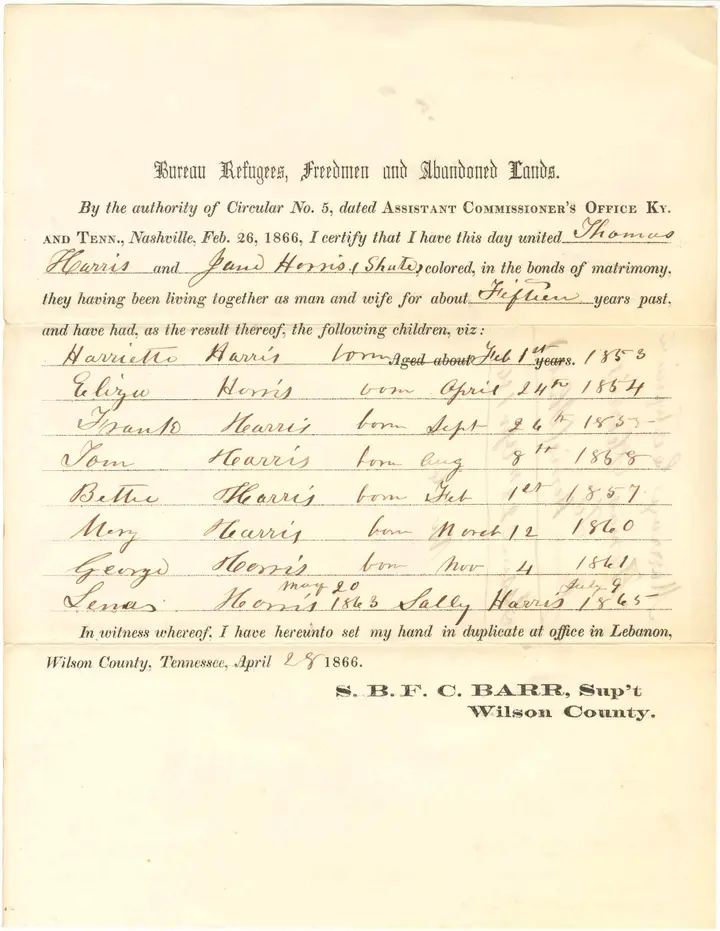 Thomas Harris and Jane Harris (Shute) marriage certificate, April 28, 1866. Freedmen’s Bureau, Tennessee; M1875, roll 4 / National Archives. Historical family record, not a modern lineage registry or proof of eligibility.Historic federal record; public domain in the United States. National Archives does not certify all third-party rights. Resized and converted to WebP; original framing retained.
Why Lineage Matters in the Legal Debate
The distinction between racial identity and ancestral lineage remains central to many discussions about reparations for Black Americans.
A lineage-based framework focuses on the relationship between present-day descendants and identifiable historical victims.
It recognizes that slavery in the United States created injuries that extended beyond the lives of those who were enslaved.
The denial of wages, property ownership, education, legal protections, and inheritance affected the ability of families to accumulate and transfer wealth across generations.
A reparations program focused on descendants could attempt to address those intergenerational consequences.
But lineage is not a complete legal solution by itself.
Program designers must still establish the government's authority, the relationship between eligibility and the identified harm, the constitutional validity of the classification, and the justification for the proposed remedy.
A credible lineage-based approach requires historical research, careful statutory drafting, and a fair process for verifying ancestral connections.
Its strength lies in establishing a defined relationship to the historical injustice being addressed, while recognizing that this relationship must still be evaluated under applicable law.
From Historical Evidence to Legal Accountability
The legal debate over reparations is sometimes framed as though the central question is whether slavery and government-sanctioned discrimination caused harm.
The historical record has already established the existence of profound injustice.
The more difficult questions concern how the law recognizes responsibility, how compensation is authorized, and how remedies can be delivered fairly.
That requires moving from broad statements of historical wrongdoing to specific legislative findings and enforceable policies.
It also requires recognizing that constitutional protections apply to reparations programs just as they apply to other government actions.
A program that fails to address these requirements risks being delayed, narrowed, or invalidated before meaningful restitution reaches eligible descendants.
This is why legal preparation must be treated as a central component of reparations advocacy rather than an afterthought.
Conclusion: Reparations Must Be Built to Deliver Justice
The movement for reparations has reached a point where historical recognition alone is insufficient.
The next challenge is transforming documented injustice into lawful, measurable, and enforceable remedies.
Every serious reparations program must answer fundamental questions about eligibility, government responsibility, constitutional authority, compensation, funding, and oversight.
These are not merely technical legal concerns. They determine whether a reparations proposal can move from public debate to meaningful implementation.
For descendants of American slavery, the stakes are substantial.
Generations of uncompensated labor, denied property rights, discriminatory policies, and obstructed wealth-building opportunities have created historical injuries that cannot be resolved through symbolic acknowledgment alone.
The legal framework must be strong enough to withstand scrutiny, fair enough to recognize legitimate descendants, and transparent enough to ensure accountability.
Reparations are not simply about recognizing what was taken. They are about establishing a lawful process for determining what is owed, who is entitled to receive it, and how restitution will finally be delivered.
The question is no longer only whether America should confront its historical obligations.
It is whether lawmakers are prepared to build the legal structures necessary to address them.
Preserving Black American history. Defending ancestral inheritance. Advancing the demand for reparative justice.
Test a Policy With the 5 Requirements Evaluator · Track Reparations Legislation · Get Reparations News Updates
See the receipts · 3 primary sources
Civic action dispatch
Now act on it
A debt documented is not yet a debt collected. See it, prove it, force it.
- 01Federal + state bills
Step 01 · Monitor
Track the bills
Follow active reparations measures in Congress and the states.
Open tracker - 023,142 counties
Step 02 · Document
Verify the receipts
Find slave schedules, Freedmen's records and land deeds in your county.
Search your county - 03Scripts + caucuses
Step 03 · Mobilize
Organize your district
Call your lawmaker, reach your Black Caucus and start a local group.
Get the playbook
Priority action · 30 seconds
Call your state lawmaker today
Copy the script, then find your representative's number on the community page.
The Reparations Brief
Stay Informed.Stay Connected.Know Your History.
Get important reparations developments, historical research, legislative updates, and original reporting delivered to your inbox.
We use your email only to send The Reparations Brief. Unsubscribe anytime. See our Privacy Policy.